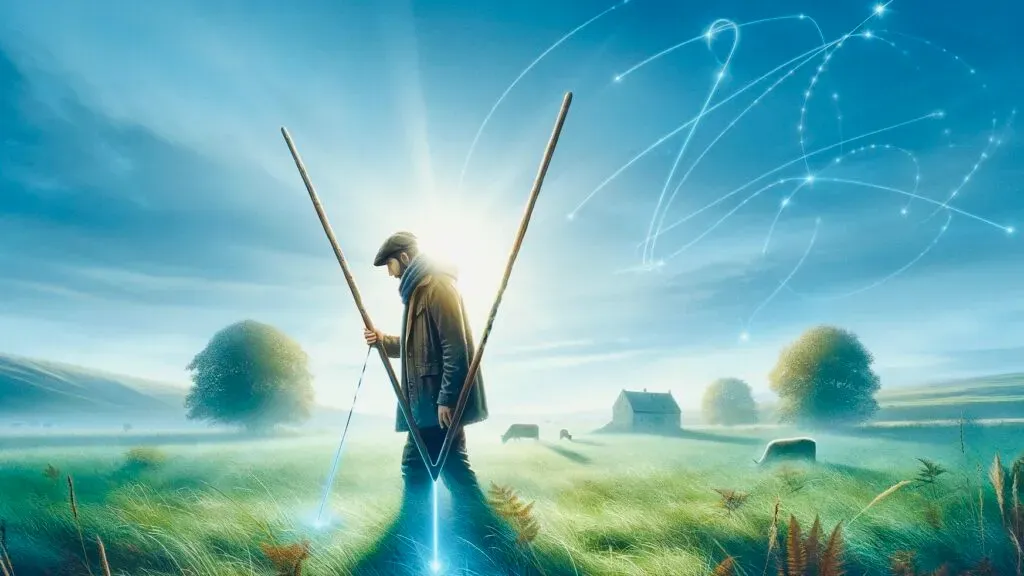
If you've spent any time in rural Eastern Washington, you've probably heard someone mention water witching. Maybe your grandfather swore by it. Maybe a neighbor told you about a dowser who found the perfect spot for their well. It's one of those topics that comes up regularly in the drilling business, so let's talk about it honestly — what it is, what the science says, and what we actually rely on when we're deciding where to drill.
What Is Water Witching?
Water witching — also called dowsing, divining, or "doodlebugging" — is the practice of using a handheld tool to locate underground water. The most common tools are a Y-shaped branch (traditionally from a willow or peach tree), L-shaped metal rods (often made from bent coat hangers or welding rods), or a pendulum on a string.
The idea is that the dowser walks across the land holding their tool, and when they pass over underground water, the stick dips, the rods cross, or the pendulum swings. The dowser then marks that spot as the place to drill.
People have been doing this for hundreds of years. It shows up in European records going back to at least the 1500s, and versions of the practice exist in cultures around the world. It's deeply rooted in rural tradition, and a lot of people we meet have genuine, personal experiences that make them believe in it.
What Does the Science Actually Say?
We want to be respectful here, because we know this is a topic some folks feel strongly about. But we also think you deserve a straight answer.
The scientific evidence does not support dowsing as a reliable method for finding water. This isn't a case where scientists just haven't studied it enough — it's been tested extensively. Multiple controlled studies, including a well-known German study that tested over 500 dowsers, have consistently shown that dowsing performs no better than random chance at locating underground water.
When dowsers are tested under controlled conditions — where they can't see the landscape, don't know the local geology, and have to identify water locations based purely on their dowsing ability — the results are indistinguishable from guessing.
The Ideomotor Effect
So why do the rods move? There's a well-documented psychological phenomenon called the ideomotor effect. It's the same thing that makes a Ouija board planchette move — tiny, unconscious muscle movements that the person holding the tool isn't aware of making. The dowser isn't faking it. They genuinely feel like the rods are being pulled by some external force. But the movement is coming from their own muscles, not from underground water.
It's a surprisingly powerful effect. Even when people know about it intellectually, they can still feel the rods moving "on their own." That's part of what makes dowsing so convincing to the person doing it.
Why Dowsing Seems to Work (Especially Around Here)
Here's the thing that most discussions about water witching miss: in many parts of Eastern Washington, you'd hit water almost anywhere you drill.
The Columbia Plateau basalt aquifer system that underlies much of our region is extensive. Water exists in the fracture zones between basalt layers across broad areas. It's not concentrated in narrow underground streams that you need to pinpoint — it's spread out through the rock formations over wide regions.
So when a dowser walks your property, picks a spot, someone drills there, and water comes up — the dowser gets the credit. But the reality is that drilling 50 feet to the left or 100 feet to the right would very likely have produced water too. The dowser didn't find the water; the water was already everywhere beneath your feet.
This is why dowsing has such a strong reputation in areas with abundant groundwater. The "success rate" has everything to do with the geology and very little to do with the method.
What We Actually Use to Find Water
When we're planning a well location, we're not guessing and we're not using divining rods. We're relying on data, geology, and experience. Here's what that looks like in practice:
Neighboring Well Logs
The Washington State Department of Ecology maintains a well log database — a public record of wells that have been drilled across the state. Every licensed driller is required to file a well report that includes the depth, the formations encountered, the water-bearing zones, and the yield. When we're planning your well, we look at what's already been documented in your area. If the three nearest wells all hit good water at 150 feet in the same basalt interflow zone, that tells us a lot about what to expect on your property.
Understanding Local Geology
Eastern Washington's geology is well-studied. The Columbia Plateau basalt aquifer system consists of layer upon layer of ancient lava flows, and the water-bearing zones tend to occur at the contacts between these layers — in the rubble zones, sedimentary interbeds, and fractured tops of individual flows. Hydrogeological maps show us where these formations are, how they're oriented, and where the most productive zones tend to be.
Across Lincoln, Stevens, and Spokane counties, we have good data on typical water depths, expected yields, and water quality patterns. That knowledge doesn't come from a stick — it comes from decades of drilling records and geological research.
Decades of Local Experience
There's no substitute for having drilled hundreds of wells in the area you work in. Over the years, you develop an intimate understanding of how the geology behaves in specific locations — where the rock changes, where the productive zones tend to sit, where you might run into challenges. That experiential knowledge, combined with the hard data from well logs and geological surveys, is what gives us confidence in our recommendations.
Our Approach: Science First, No Judgment
We want to be clear about something: we're not here to make anyone feel foolish for believing in water witching. It's a long-standing tradition, and the people who practice it are usually sincere. If your uncle wants to walk your property with a willow branch before we drill, we're not going to argue with him.
But when it comes to deciding where to place a well — a decision that involves thousands of dollars and will affect your property for decades — we stake our reputation on science and experience. We look at the well logs. We study the geology. We draw on what we've learned from years of drilling in this specific part of the world.
That approach has served our customers well, and it's the one we'll keep using. We'd rather show you the data from your neighbors' wells than wave a stick over your pasture. And we think once you see how the science works, you'll feel a lot more confident about where your water is coming from.
The Bottom Line
Water witching is a fascinating piece of rural heritage, and we understand why it persists. But the science is clear: it doesn't reliably locate water. In our part of Eastern Washington, dowsing appears to work because groundwater is widespread — not because the method itself is valid.
When you're making a real decision about where to drill, you want real information. Geological data, well logs from surrounding properties, and a driller who knows the local formations inside and out — that's what gives you the best chance of a productive, long-lasting well. And that's exactly what we bring to the table.